Showing posts with label mobile CRM. Show all posts

Wednesday, November 12, 2008

Unleashing the Power


In today’s post I thought I would explore a side which we have yet to fully delve into here at Mobile CRM Japan. That is the use of mobile based CRM systems for the sole intent of adding both versatility and potency to one’s workforce. What I mean by this, is that if your company has a number of workers who are mobile--pardon the pun—or out of the office for major portions of their day, a well chosen CRM application can do wonders for enhancing worker productivity, modernizing and smoothing out of business operations and logistics, as well as amplifying overall customer services levels.

This push towards establishing a mobile based CRM system which has the ability to connect workers via a mobile phone to the office and allow for increased functionality is a notion that will become increasingly more important as businesses look for new and more efficient ways to service their customer’s needs. The fact is that today’s technology is evolving to the point in which this real time sharing of information is not only possible but soon to be a standard in business operations for competitive firms. Without tapping into this resource companies are putting themselves at a distinct disadvantage to direct competitors who are embracing this technology. Additionally, what should help in the adoption of this type of technology is that it is becoming more affordable for SME’s—small to medium enterprises. This news should be music to the ears of companies in Japan which is around 98% SME dominated.

To clarify both the importance and functionality issues even further, let’s say your company manufacturers, sells and services ‘ABC widgets’. Within your employee base you have two divisions which spend a number of hours in the field. One is your sales force selling your ABC widget and the other is your servicing division consisting of on-site service technicians who service your product. Your sales force should have instant access to information which may assist in enabling a transaction or closing a deal, such as the placing of an order, updating relevant customer information details, or checking inventory. Equally, your technicians should have the ability to attain instant access to company troubleshooting manuals, part numbers, part delivery orders and so on. All of this and more should be able to be performed through a wireless device so as to shorten the lead to cash cycle, increase efficiency and ultimately satisfy the customer needs.

Current mobile devices coupled with today’s rapid evolution in technology certainly have the power to unleash a host of applications aimed at helping businesses strengthen operations. Here in Japan, like most of the other industrialized worlds such a shift is certainly underway however the race is on. It is our thinking here at Mobile CRM Japan that the companies who fully embrace this mobile based CRM technology and thoughtfully single out what it can do for them, are the companies which will ultimately position themselves to thrive.

Canadian Chris

Thursday, November 6, 2008

History in the Making and in More Ways than One


Well, today we officially welcome the next U.S. president elect to the fold. Barack Obama will certainly have his hands full with the number of issues America faces. This blog is not political in nature however one cannot deny the significance of this moment. As a side note however, this point in American history is being captured and read in ways never imagined and that is what is catching my interest today.

To be more succinct, I just finished watching a news clip from the American news outlet ABC and how the Obama campaign won the young voters. They turned out in huge numbers to support his campaign. This group certainly played an instrumental role in him capturing the presidency. Why did the younger generations suddenly come alive and present themselves at the polls? Traditionally that vote has always been difficult for any candidate to capture. One could certainly point to the issues of the day truly impacting the American people and an utter dissatisfaction with the last administration. The mounting frustration and emotional strains caused by the current government’s policies such as the Iraq war. These policies were potentially hitting home in ways that haven’t been felt in a long time. I believe that these are but a few of the reasons for this young voter presence. One that I would like to look at today however is from the mobile technology side of things.

With today’s sources of news--traditional print, television, radio and word of mouth--playing their usual roles in influencing people’s thoughts, actions and beliefs, I am struck by just how fast the mediums of communication are changing. Today, as we can see, the young in particular are gravitating towards new sources such as the internet and even mobile web to fulfill their needs for the latest news. They may find this info from trusted news sources or they simply read an unfiltered blog.

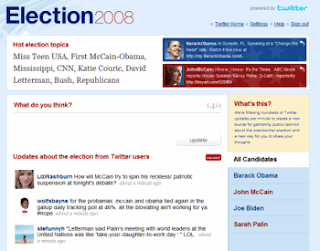
To say this technology and the associated trends are not having an impact would be an understatement. Just look at what the company Twitter has been doing as of late and what role it has been playing in the election. For those of you not familiar with Twitter this company allows users to send short messages of up to 140 characters from a mobile phone or computer to other ‘followers’. The significance of this is that it has taken off in the States with news and opinions being shared by millions at any given time. It has become so huge that while Obama was campaigning against both Clinton and McCain he actually had an account set up and used it as a tool to connect with voters. He continued to use this service for the duration of his campaign and even sent a message upon winning the Presidency. Do not get me wrong, I am not suggesting that this particular service or technology itself was a decisive factor in this win. However, one cannot discount the affects that mobile related services such as Twitter may have had in uniting young people, challenging ideals and potentially swaying hearts and minds to a certain extent.

Another site created by Twitter tracked the current sentiment of the American people in a way that has never been done before. Basically this site tracks all the political messages on the service. Twitter regularly determines a set of 'Hot Election Topics' and displays every tweet that fits into these categories in an automatically updating stream. This type of technology certainly has the potential to galvanize voters, the younger ones in particular, as the way this information is presented is so new, hip and up to date.

The key to tech based info sharing services such as Twitter is this notion of always on and always available. Of course you can use a home based computer to log messages, however what really runs this engine is the mobile, with most users firing off these messages using their ketai’s.
As you can see here, the power of the mobile is there in a way which allows businesses to build powerful CRM tools to collect information, track sentiment and in some cases alter courses of action or even history. I hope you enjoyed today’s post and as always comments are welcome.

Canadian Chris

Tuesday, October 14, 2008

The Nuts and Bolts of Global Mobile Stats


I recently came across a nice little online presentation of global mobile stats—1H 2008—assembled by the ever in touch Chetan Sharma. He is the author of Mobile Advertising: Supercharge Your Brand, as well as a new book entitled Wireless Broadband: Conflict and Convergence. His insights and coverage of mobile developments are always sharp and certainly worth reviewing if one truly wants to get a feel for where things are in terms of growth and expansion of mobile markets. As such, I would like to throw a few of his nuts and bolts stats together for you in this post today.

· Global wireless markets continue to grow rapidly with China and India adding about 9M subscriptions a month. India currently has over 300M subscriptions and China has over 600M.
· Global mobile revenues are likely to reach over 1 trillion (U.S. figures) with 800 billion being attributed to service revenues.
· Mobile Data is contributing close to 40% of revenue for leading operators
· Overall, the world market mobile penetration rate is now over 50%
· The U.S. edged Japan again as the most valuable mobile data market in service revenue with the U.S. coming in at $15.7B versus Japan at $13.6B. As a side note, China was third with $7.8B.
· During the last nine years at DoCoMo overall APRU has declined 33% though data APRU has increased over 1800% and accounts for over 40% of revenues. Voice APRU has declined nearly 60% in that same time.
· For the last couple of years DoCoMo has been the only carrier exceeding $10B in yearly revenue, however later this year expected newcomers to this exclusive club are KDDI, Verizon Wireless and ATT.
· China Mobile is number one in subscriptions at 428M with Vodafone number two at 269M and coming in at third was China Unicom at 171M.

Rank by subscriptions:


1) China 2) India 3) U.S. 4) Russia 5) Brazil

Rank by Data Revenue:

1) U.S. 2) Japan 3) China 4) U.K. 5) Italy


Well, as you can see these stats are enlightening in many ways, as one could spend a post dissecting each point. I hope these stats are helpful for those looking to gain that global perspective of where the global mobile market really is. To see the full presentation please, see
Chetan Sharma’s blog site as it is chalked full of various stats and other goodies.

Canadian Chris

Tuesday, October 7, 2008

"The Times They Are a Changin..."


Exciting times we are living within I say. It sometimes takes a moment, thought or experience for that powerful realization to kick in though. I had one of those conscience awakening flashes this past week. I was thinking about this mobile revolution we are living through these days and just how quickly the technology is evolving. It really doesn’t seem all that long ago, when we were all gaga over the internet and what it potentially had to offer. Now, I know the internet is still developing and has much more to offer, however, one would be missing something if he or she didn’t realize that there has been a distinct shift in focus for a lot of companies—Google, Microsoft, Apple—towards mobile technology and development and this little device, which nearly all of carry on a daily basis.

The ubiquitous or ‘always on’ nature of this tool has had people drooling over possibilities for years. Since the keitai’s (Japanese word meaning mobile) inception the possibilities and discussions of developing a universal ‘life remote control’ have been thrown about more times than one can count. However, ten years back or even five years ago those were all just possibilities. Well, fast forward to the present and look around! My, oh my, have we come a long ways from those dreams.

To add some perspective, I picked up Rick Matheson’s book entitled Branding Unbound which basically covers the ‘future’ of advertising, sales and brand experience in the wireless age. This book was first published in 2005, which just under four years ago. Not that long ago right? Wrong! Especially if you are thinking in terms of keitai development, mobile CRM systems and the like! I found a passage in his book—which is an excellent read, or rather was excellent in 2005, but now somewhat dated and most useful to geeks like myself, who blog about the historical evolution of mobile developments. Yes, I am a techno. nerd. However, this book really allows one to see just how far we’ve come. Read, reflect and enjoy a quote lifted from Branding Unbound and an individual called Kenny Hirschorn, the director of strategy, Imagineering, and futurology for U.K.-based mobile carrier Orange:

A few years from now, the phone call is going to be the lowest piece on the food chain. Of course, we will still facilitate voice communication. But on a daily basis, we will also awaken you in the morning. We will read you your email. We will start the oven. We will arrange transportation to and wherever you want to go. At the office, we will provide you with information and news.”

Check, check and check so far, in terms of what we are currently doing.

“We will translate information into foreign languages, or translate information into your language for you. We will track your health. We will track your family member’s location, if that’s what you want. We’ll be your bank, we’ll provide you with customized news and entertainment and we’ll even monitor your housing security as you sleep at night.”

Sound exciting? Not really eh. Why? Well, we have that technology right now, at least within Japan. That is all pretty much basic and wouldn’t raise an eyebrow to most within this country. That however, is my point you see, This device is rapidly altering the way most of us live and this change is happening now!

Companies or individuals willing to put the time in are leading the charge now, but as we all know, the old adage about today’s leader not always equaling tomorrow’s is something to keep in mind. Especially, for those of us who are big or small movers and shakers in this world of mobile technology and development. Just as Bob Dylan had it right in the sixties with his album about change and revolution, I too would like to join the chorus and hum away to these changin times.


As always, I invite comments about this post and others. In addition, I invite comments on how to introduce more readers to our blog.

Canadian Chris

Tuesday, September 30, 2008

The 'iPhone' in Japan and how 'i' see it...


Well, as another week starts off so does another addition to this running mobile CRM blog. In this post I would like to get back to some more specific and timely issues relating to mobile CRM. I had a look through some of my most trusted sites for ideas and found an interesting piece from one of my favorite sites covering the mobile industry in Japan Wireless Watch Japan. The article covers Apple’s potential failure to reach it’s target of 1,000,000 iPhones sold in Japan. At present Mr. Job’s company is on pace to record less than 500,000 units sold according to market research firm MM Market Research. As the articles notes these assumptions were built on one year’s full sales coupled with competitive pricing centering on package price, handset and monthly fees. What gives you might ask? All of the above seem to be in line with what is being offered by Japanese competitors in terms of pricing.

Well, the possible explanations as in most cases are not found by analyzing surface based facts or assumptions. We need to dig a little deeper. The WWJ article notes the challenges any foreign mobile company faces here in Japan which is the maturity of the market within Japan in terms high end technology already being offered by most manufacturers. As I thought about this longer, I came back to some of my Japanese business cultural studies I have been formally embarking on these past couple months and one point flashed through my mind. It was a point regarding keys to success in Japan and it stated that whatever product or service a foreign company is attempting to offer it must research and produce the ‘right’ product for Japan.

Now here we have the iPhone selling nearly 200,000 units in the first two months and suddenly deadpanning to an averaged pace of approximately 30,000 units a month sold for the remaining ten months. I might add that this assessment is a positive one according to some. We clearly have some forces at work which are undermining the iPhone’s success. Could they lie within this notion of Apple underestimating the distinct tastes Japanese consumers have versus American’s? I am confident that this is part of it but a lot of it surely centers on the market and how advanced it already is. Sure, the iPhone has the touch screen and an interesting presentation which is a novelty and something new for consumers here, however notions of surfing the net, listening to music, playing games, checking weather and other useful functions the iPhone offers are all somewhat stale mobile CRM applications offerings for the average keitai user here.

Beyond this, I have read and also heard first hand grumblings from people over somewhat minor issues relating to no attachment loop for mobile straps, to the necessity of changing of one’s mobile email address despite already being a Softbank user. These issues I understand, are just a sampling and in no way can be thought of as the chief deficiencies relating to the poor sales forecasts, however collectively they offer a sampling of potential shortcomings.

To me, these issues add up to a particular company not providing a unique enough device for a truly unique market. The units sold speak for themselves thus far, illustrating that even huge conglomerates are no less insulated from simple market principles than any of us. And this folks, returns us to one of the keys to success here in Japan or any global market, which is researching and manufacturing the right product for the consumer. As always, comments would be appreciated!

Canadian Chris

Tuesday, September 23, 2008

A Continued Cultural Kick!


Well upon re-reading couple of my last posts I see that I have been on a bit of a cultural kick as of late. Illustrating ideas relating to Japanese culture more so than the strictly mobile CRM related issues. I had a momentary thought which said balance, balance, balance. I should get back to the nuts and bolts of this blog which is mobile CRM related content. However, I took a moment, looked over this ‘illustrious’ blog explanation and re-thought this logic. Aside from being a take on mobile CRM issues, these posts are also about examining the cultural business issues here in Japan. That aspect unto itself deserves an extended examination. If one cannot understand the social or ethnic factors at play here, one most certainly cannot put quality CRM business management systems or decisions for that matter into play. With that, I will turn towards this week’s topic of looking at what some feel it takes to make it here in the Japanese market.

Lately, I have been reading up on a number of books specifically relating to the examination of Japanese culture and more specifically business practices. I am sure this is where a lot of these thoughts and feelings have been deriving from as of late. One particular book entitled
Cracking the Japanese Market by James C. Morgan and J. Jeffery Morgan examines these issues and more. There has been one particular section which has stood out for me thus far. It centers on understanding the rules at play. The authors argue that you must develop a philosophical foundation upon which to base your strategy. These components include:

-Presence
-People
-Pioneering
-Piggybacking
-Partnering
-Persistence

Now for the sake of simplicity and ease I will not elaborate upon each point into any great detail for the sake of keeping your attention, however I do wish to add a few points which I feel are pertinent to this blog and this post in particular.

Presence: It is incredibly important for your organization to have a physical presence in the Japanese market. I might add that this is specifically important when relating to the mobile CRM market. This is where you stand the best chance to gain invaluable information about first understanding distinctly Japanese customer needs as well as their ever changing desires.

People: This simply relates to localized hiring and it is important for two reasons. One it shows commitment to the market and two it opens doors with other Japanese companies in terms of building and nurturing both supplier and customer relationships.

Pioneering: Japan is renown for companies which will jump on popular ideas and re-create the service or product with its own twist. Therefore, it should be expected that your product or service will never be alone long. These companies include both large and small with the big companies coming first and the second wave of small to mid-size companies following. Obvious counter strategies include patent protection as well as constant innovation.

Piggybacking: Due to Japan’s long history of complex relationships it has been difficult for foreigners to enter and or build network distribution systems. However, one way to by-pass this obstacle is to engage in ‘piggybacking’ companies with similar products or services with already established distribution networks. The key according to Morgan and Morgan is to leverage people rich companies and existing structures, many of which hungrily need new product and ideas.

Partnering: The notion of partnering with an established Japanese company is an obvious method to gain access to customers, suppliers and buyers. Trust and relationship building which are ever so important to the Japanese way of business can then be forged. Of course one must be sharp in the structuring of the partnership so that theorized advantages stand the chance of becoming a reality.

Persistence: This concept is particularly important in that it shows commitment. Japanese business ethics highly value trust and commitment. Results are often examined with the long view in mind rather than the short. One way to show this is the ‘sticking it out’ mentality within the market. This mettle goes along way in terms of showing the Japanese your particular company or personal traits. It goes even further if your product has any type of CRM twist to it!

Now, if you are still here with me I hope these points do strike a cord for some of you whether you are already in the market or are curious about it. These ideas are of course simply jumping off points to further research however I hope that they have been of some genuine assistance.

Canadian Chris

Tuesday, September 16, 2008

Revisiting the Roots...


Recently I went on a ten day trip back home to Canada and as usual was reverse culture shocked by a number of different things extending from extreme customer service standards ranging from exemplary to downright poor. A lot of this stems from Canadian culture being a lot more direct with actions often seeming dependant on the mood of the service provider. This mind you is on the micro scale and relating to services at or within restaurants, gas stations, ticket kiosks, clothing stores etc. These interactions contrast highly with that of Japan in that these low level service opportunities are almost always at an extremely high level of service. To make this point simpler to understand, just walk into a MacDonald’s here in Japan and do a mental comparison about how that situation would differ in your home country. This notion is not something new and is a point I touched upon in an earlier blog upon reading Tim Clark and Carl Kay’s book Saying Yes to Japan. I suppose that visiting one’s home and experiencing it yet again one is struck by how true this.

These thoughts led me to the other points Clark and Kay drive home of which they state the higher end services are usually at a much higher level outside of Japan. It seems that as the transaction values go up along with the customer’s stake in the transaction the service levels go south. This is where the opportunities lie for those willing to dig below the surface. A few more interesting points that were raised in the book mention that successful foreign entrepreneurs exhibited five traits that seemed to give them an edge within Japan. These included:

1) propensity for risk taking
2) flexibility
3) customer focus
4) tech driven speed
5) professionalism

As you can see these points are not rocket science or difficult to build CRM systems around however for many Japanese businesses certain aspects are inherently difficult to master just as it would be within say America to replicate distinctly Japanese traits. In particular the propensity for risk taking would certainly be a major obstacle for a number of Japanese.

My point thus far centers on this notion of recognizing these differences and what that can mean for you or your business whether or not it is mobile related. The challenge of course is the recognition of POG/SOG’s –product/service opportunity gaps—and in order to do this one must routinely be questioning commonly accepted practices as to whether or not true value is being delivered to the end user.


I understand that these points about finding gaps and delivering value, customer focus etc. which I raised in this particular blog are not new or particularly flashy. They are the crux of basic business study and central themes of a myriad of books put out each year. My point and one that I strongly feel should not be lost is that these basic points need to be acknowledged at all times and how context or culture, to be more specific can really rattle these notions thus creating opportunities for those on the look out. As always I invite comments or thoughts!


Canadian Chris

Tuesday, August 5, 2008

"Twitter" - an alternative mobile CRM system


Over the past several months I have been closely following the developments of a new blogging service or should I say microblogging service in order to see if it could be utilized as a mobile CRM system. This new microblogging service called Twitter, allows users to send "updates" (up to 140 characters long) to the Twitter web site, via the Twitter web site, mobile phone short message service (SMS), instant messaging, or a third-party application. Updates are instantly delivered to other users who have signed up to receive them and are received via the Twitter website, instant messaging, SMS, RSS, email or through an application.

Basically, Twitter and alike services (Pownce, Plurk and Jaiku) enable people to blog in between blogs in real time and enable friends or followers to get a better insight into their daily life, thoughts and opinions.

So, if friends and followers are able to get a better insight into their daily life, thoughts and opinions.....how can it be used as a mobile CRM system for customer centric companies?

Recently, customer centric companies have been monitoring social media such as blogs, social networking sites and now even microblogging in an effort to better understand and satisfy customers. Companies are adopting and adapting to social media and the web 2.0 in order to extend and further develop their CRM systems, through such services as Twitter. Twitter enables companies to further integrate mobile CRM via:
  • responding to any customer service issues in real time

  • enabling an instant consumer feedback system

  • providing higher clickthrough rates to relevant content

  • interacting in relevant discussions and topics of thought leadership

  • enabling a great networking, marketing and brand awareness tool

  • enabling the ability to create push/pull content and advertising, and

  • providing a open social network for affinity marketing

As one can see, Twitter certainly bridges the gap for mobile customer relationships and now with new microblogging services popping up in Japan, such as timelog and mogomogo, it is only a matter of time until Japanese companies start tapping into this mobile CRM free resource.

Australian Chris

Wednesday, July 30, 2008

Why mobile CRM? (Mobile Customer Relationship Management) PART II


Why the emphasis on mobile CRM? Well, the answer is simple and all around us literally. As noted in the aforementioned post, keitai’s (Japanese word meaning mobile phone) are simply surrounding us. Just looking at the current population estimates from Stats Japan we see the current estimate as of July 2008 is sitting at 127,720,000 and then simply referencing the number of ketai’s on the market as provided by Wireless Watch Japan—103,045,300 as of June 2008---we come to realize that the penetration rate is extremely high. What this means is that it is becoming increasingly more difficult to find a person, young or old who doesn't own or at least know how to use a keitai. The ramifications of this simple observation are quite large in that it has opened up a new realm of opportunities for many who feel that the next digital frontier is currently expanding all around us. And to some the significance lies in that this expansion is taking place in the palm of our hands.

These facts have certainly not gone unnoticed as Dentsu—A Japanese company and one of the largest advertising firms worldwide—noted that mobile revenues exceeded half a billion U.S. dollars for 2007 and are expected to double within the next four years. Couple this with the fact that a lot of these revenues are now coming from the content being produced rather than pure advertising dollars. It must be noted however that for this type of development to be occurring the basic infrastructure must be set to promote it. From a more detailed look within Japan one can definitely see some of the pieces which have allowed for this development:

  • the phones themselves are high tech (4 in 5 are 3G)

  • the partnerships between the operators and manufacturers are complementary

  • operators have been offering unlimited use plan packages for quite some time

  • walled gardens are crumbling and operators allow this

  • heightened user experiences are emphasized

  • standardization efforts from competing operators

From this, there has been a flood of content onto the mobile in recent years ranging from mobile manga (comics) to music, to games, auctions, shopping, SNS, television to content aimed at creating and enhancing digital cash and coupon functionality, as well as that of GPS mapping applications. This device has literally woven itself into the fabric of society to the point that you are undoubtedly a bit of an anomaly if you are without. This is especially true if you are part of the youth movement.


So, with penetration rates already so high, keitai technologies constantly evolving and many product, service and content based businesses already established both on-deck and off-deck, the rules for interacting with these consumers are changing.


In particular opportunities relating to the development of mobile CRM software applications and tools which enable and enhance mobile driven sales, as well as bolster support marketing relationships are certainly increasing. The nice thing is that despite the development already taking place and the rush to get into this market here in Japan---and globally for that matter---it is still early. It is our hope that through the sharing of perspectives like these and from other users new ideas will be generated which will hopefully lead to a deeper understanding and thus better opportunities for those of us with a keen interest in mobile CRM development.

Canadian Chris

Tuesday, July 29, 2008

Why mobile CRM? (Mobile Customer Relationship Management) PART I

With the ongoing and rapid integration of mobile phones (keitai - Japanese word) in today's society, especially in Japan and Asia, and with marketers and companies looking for the new frontier, keitai users are the "new" consumers. The notion of "new" consumers will merely develop into the traditional term, as keitai use is becoming ubiquitous with consumers in Japan and throughout the world. Thus, with the ubiquitous nature of keitai in Japan, a shift to mobile CRM as apart of a companies overall CRM system is becoming a necessity.

Mobile CRM is one apsect or subset of eCRM or electronic CRM but slightly differs in nature. Mobile CRM or Mobile Customer Relationship Management is
defined as “services that aim at nurturing customer relationships, acquiring or maintaining customers, support marketing, sales or services processes, and use wireless networks as the medium of delivery to the customers".

But, why mobile CRM? And, what is the importance?

Australian Chris