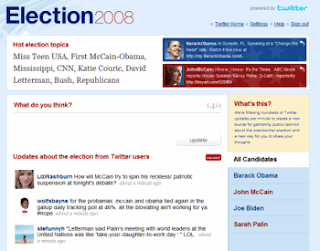
Well, today we officially welcome the next U.S. president elect to the fold. Barack Obama will certainly have his hands full with the number of issues America faces. This blog is not political in nature however one cannot deny the significance of this moment. As a side note however, this point in American history is being captured and read in ways never imagined and that is what is catching my interest today.
To be more succinct, I just finished watching a news clip from the American news outlet ABC and how the Obama campaign won the young voters. They turned out in huge numbers to support his campaign. This group certainly played an instrumental role in him capturing the presidency. Why did the younger generations suddenly come alive and present themselves at the polls? Traditionally that vote has always been difficult for any candidate to capture. One could certainly point to the issues of the day truly impacting the American people and an utter dissatisfaction with the last administration. The mounting frustration and emotional strains caused by the current government’s policies such as the Iraq war. These policies were potentially hitting home in ways that haven’t been felt in a long time. I believe that these are but a few of the reasons for this young voter presence. One that I would like to look at today however is from the mobile technology side of things.
With today’s sources of news--traditional print, television, radio and word of mouth--playing their usual roles in influencing people’s thoughts, actions and beliefs, I am struck by just how fast the mediums of communication are changing. Today, as we can see, the young in particular are gravitating towards new sources such as the internet and even mobile web to fulfill their needs for the latest news. They may find this info from trusted news sources or they simply read an unfiltered blog.
To say this technology and the associated trends are not having an impact would be an understatement. Just look at what the company Twitter has been doing as of late and what role it has been playing in the election. For those of you not familiar with Twitter this company allows users to send short messages of up to 140 characters from a mobile phone or computer to other ‘followers’. The significance of this is that it has taken off in the States with news and opinions being shared by millions at any given time. It has become so huge that while Obama was campaigning against both Clinton and McCain he actually had an account set up and used it as a tool to connect with voters. He continued to use this service for the duration of his campaign and even sent a message upon winning the Presidency. Do not get me wrong, I am not suggesting that this particular service or technology itself was a decisive factor in this win. However, one cannot discount the affects that mobile related services such as Twitter may have had in uniting young people, challenging ideals and potentially swaying hearts and minds to a certain extent.
Another site created by Twitter tracked the current sentiment of the American people in a way that has never been done before. Basically this site tracks all the political messages on the service. Twitter regularly determines a set of 'Hot Election Topics' and displays every tweet that fits into these categories in an automatically updating stream. This type of technology certainly has the potential to galvanize voters, the younger ones in particular, as the way this information is presented is so new, hip and up to date.
The key to tech based info sharing services such as Twitter is this notion of always on and always available. Of course you can use a home based computer to log messages, however what really runs this engine is the mobile, with most users firing off these messages using their ketai’s.
As you can see here, the power of the mobile is there in a way which allows businesses to build powerful CRM tools to collect information, track sentiment and in some cases alter courses of action or even history. I hope you enjoyed today’s post and as always comments are welcome.
Canadian Chris


